
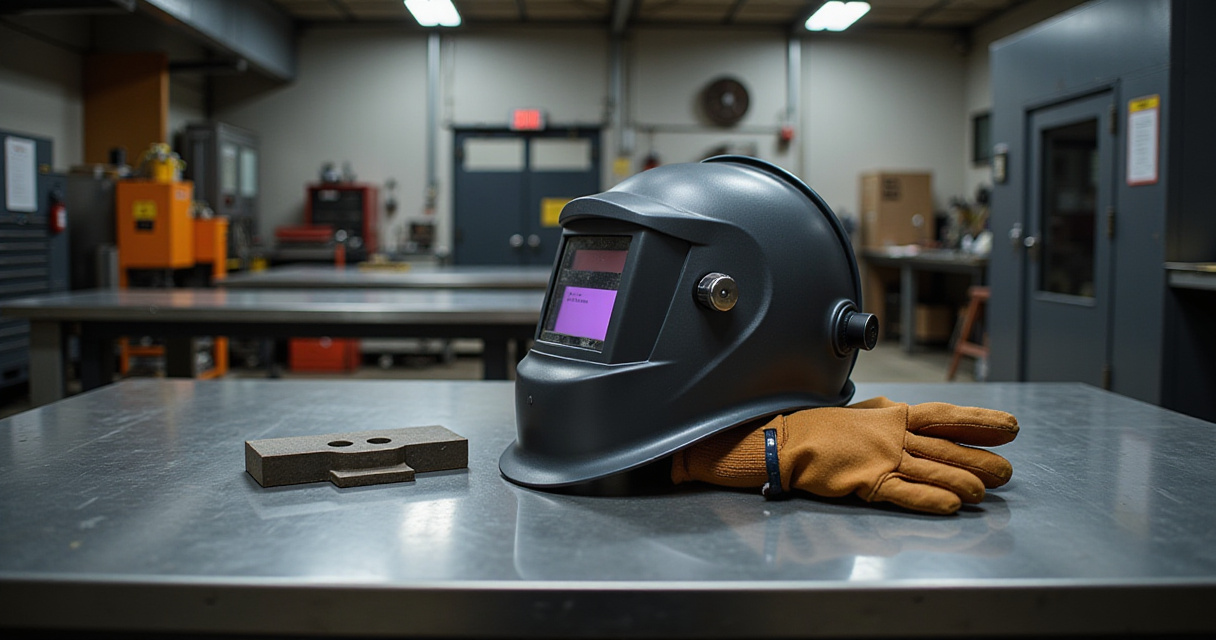
Skilled welders are among the most sought-after trade workers in America today.
Manufacturing plants, shipbuilding docks, oil pipelines, and heavy construction all depend on workers who can fuse metal, and most will bring someone on quickly when they show up with the right foundation.
The pay holds up well for a career that requires no college degree, and the skill moves with you from one employer or state to the next.
Cost used to be the barrier. Vocational welding programs could cost thousands before you ever lit an arc.
That barrier has come down. The theory, safety basics, and core fundamentals are now available online for free, whenever your schedule allows.
This guide explains what welding certification actually means, which free courses are worth your time, and the realistic path from completing a free course to landing a paid welding job.
Start learning to weld today
Free, self paced, and you finish with a real certificate of completion.


Why welding is a solid career move
Few trades offer a faster path to skilled, well-paying work without a four-year degree.
The median welder earns about $51,000 per year, and the top ten percent bring in over $75,000, per Bureau of Labor Statistics data.
Starting wages are lower, but they rise steadily as you add processes and earn certifications over time.
Openings stay consistent for a clear reason. The field is not growing dramatically, but it loses experienced workers to retirement every year.
The BLS projects roughly 45,000 welding job openings per year over the coming decade, driven mainly by replacements rather than expansion.
That steady churn creates genuine, recurring opportunities for newcomers, even if the overall growth rate looks modest on paper.
Niche specialties pay considerably more. Traveling, pipeline, and underwater welders routinely earn above the median.
Those roles come after experience, not at the start, so use the median figure as your realistic baseline for what to expect early on.
Where welders find work and which sectors pay best
Welding is a transferable skill applied across many industries, and the sector you choose has a big effect on pay.
Most new welders begin in fabrication shops or manufacturing, producing everything from structural components to trailers and equipment frames.
Construction work brings in welders for bridges, commercial buildings, and structural steel, often with competitive pay and consistent overtime.
The top earnings come from the tougher environments. Aerospace, shipyard, pipeline, and underwater welding all pay well above the national median.
Those positions demand advanced skills, additional certifications, and sometimes difficult conditions or extended travel to earn that premium.
A straightforward plan works best. Build a clean foundation in a shop, sharpen your technique, then pursue whichever specialty matches your income goals.
What getting welding certified actually takes
There is a lot of confusion on this point, so here is the clear version.
Completing a free online course gives you a certificate of completion, which documents that you worked through the material.
That is distinct from a professional welding certification, the credential employers actually look for when hiring.
The leading credential is the AWS Certified Welder designation, issued by the American Welding Society.
- No required class. You do not need a course first, but you do need the skill in your hands.
- A hands on weld test. You weld in set positions and processes at an AWS Accredited Testing Facility.
- Ongoing maintenance. You confirm you are still welding every six months to keep it active.
The test runs a few hours and takes place in person on real metal, evaluated against AWS code requirements.
No app or video series can substitute for that. The physical ability has to be demonstrated on the spot.
What online welding training can teach you, and where it ends
An online welding course covers exactly what a screen is equipped to deliver.
Lessons walk through welding processes, shop safety, basic metallurgy, and how to read blueprints and weld symbols.
Most platforms track your progress automatically, so you can study during lunch breaks or a few evenings a week.
Once you finish, you receive a certificate of completion that adds something meaningful to a resume.
What it will not develop is hand-eye coordination. Putting down a clean bead requires a machine, repetition, and time.
Think of the free course as your first step and your foundation, not as the final destination.
What a free welding course actually covers
A quality online welding course gives you the knowledge base you need before touching a torch. Typical topics include:
- Inspection basics and how to identify common weld defects
- Shop safety, personal protective equipment, and fume and fire hazard awareness
- The major processes: MIG (GMAW), TIG (GTAW), stick (SMAW), and flux core (FCAW)
- Reading blueprints, weld symbols, and joint configurations
- Fundamental metallurgy and how different metals respond to heat
Arriving with this background means your hands-on hours go toward refining technique, not catching up on basics.
Which welding process is best for beginners?
Four main processes exist, but you do not have to master them all before getting started.
MIG (GMAW) is the most beginner-friendly and the most widely used in shops, making it the natural first choice for newcomers.
It is tolerant of small errors and fast to run, with applications ranging from auto bodywork to general fabrication.
Stick (SMAW) is a strong follow-up. It handles outdoor conditions, wind, and imperfect metal surfaces that would stop other processes cold.
TIG (GTAW) demands the most control and delivers the cleanest results, particularly on thin metal, stainless, and aluminum where appearance matters.
Start with MIG to build a solid base, then layer in stick and TIG as the jobs you are targeting begin to require them.
Top free and low-cost welding courses worth your time
Every option below is legitimate, and we have been straightforward about which parts are truly free and which carry a charge.
None of these courses certify you to work as a professional welder. They focus on theory and foundational knowledge only.
| Platform | Cost | Format | Best for |
|---|---|---|---|
| Alison | Free | Web course | A well-known free course that includes a completion certificate |
| Cursa | Free | App + web | Fully free access including the certificate at no cost |
| SkillCat | Free basics | App + sims | Mobile-friendly lessons with a strong focus on welding safety |
| Lincoln Electric | Free | Videos / academy | Process training from one of the most respected names in welding |
| AWS Learning | Paid (~$350) | Self paced + exam | An official AWS certificate and CEUs |
If you need one place to start, Alison’s welding course is free, widely recognized, and closes with a certificate.
How much time and money you actually need
The online theory portion is the quick, affordable part. Most free courses run from a few hours to a couple of weeks at your own pace.
Developing real hands-on ability takes longer. A dedicated welding certificate program typically spans three months to a year.
Costs follow the same pattern. Theory is free, but the practical training and formal testing are where the expenses appear.
The AWS Certified Welder application fee is around $75, with a small renewal fee required every six months to stay active.
The actual weld test at a facility typically runs $300 to $450, depending on the process and position being tested.
If budget is a concern, start with the free options. Veterans and young adults may qualify for free training through programs such as Job Corps.
Can an online course replace in-person welding training?
No, and this is the point that trips up most beginners.
A free online course teaches theory and gives you a certificate of completion. It does not make you employable on its own. You still need hands on practice and, for most jobs, a passed weld test before an employer will hire you. Any site promising a real welding job from an online course alone is overselling it.
Welding is a physical trade, measured entirely by the quality of what you produce.
That quality is built in a community college program, a trade school, an apprenticeship, or through on-the-job work in a shop.
The free course flattens the learning curve and signals initiative to employers. It does not stand in for arc time.
Do employers recognize an online welding certificate?
It depends on the role it is playing.
As evidence that you know the fundamentals and sought out training on your own, it strengthens your application.
As a direct substitute for a hands-on weld test, no. A shop will still expect to see you weld in person.
The right approach is clear. Study for free, absorb the theory and safety knowledge, then prove your skill in front of someone.
When a specific certification is listed in a job posting, target the AWS Certified Welder exam at an accredited testing facility.
Warning signs to avoid
Free welding certificates draw a lot of search traffic, and that attention brings some unreliable providers along with it.
Avoid any site that claims to issue an instant welding certificate with no coursework and no test.
Be skeptical of pages suggesting that finishing an online course is equivalent to earning an AWS certification or a welding license.
And steer clear of anything charging a large upfront fee for a certificate that no real employer will recognize.
Trustworthy platforms are transparent about covering fundamentals only. That honesty is the clearest sign you are in the right place.
How to move forward from here
Breaking into welding no longer requires a large upfront investment.
Choose one of the free courses listed above and work through the theory within the week.
From there, find a way to get hands on a machine through a local class, a trade apprenticeship, or an entry-level shop position.
Once the skill is there, schedule a weld test or pursue the AWS Certified Welder exam to make your qualifications official.
That is the path from curious to employed: free theory, real practice, a passed test, and a paying job.
Frequently asked questions
Is it possible to get a welding certificate online at no cost?
Yes. Sites like Alison and Cursa offer free welding courses that come with a free certificate of completion. Keep in mind that a completion certificate confirms you covered the theory; it is not a professional welding certification by itself.
Is an online course enough to become a welder?
No. Online courses build theoretical knowledge and safety awareness, but welding is a hands-on trade. You need real practice time and, for nearly every job, a passed weld test before any employer will bring you on.
What do welders typically earn in the United States?
According to the Bureau of Labor Statistics, the median welder earns around $51,000 annually, with the bottom tenth earning under $38,000 and the top tenth exceeding $75,000. Specialty welders, including those in pipeline work, earn considerably more.
Can you take the AWS Certified Welder test online?
No. The AWS Certified Welder test is a practical, in-person exam conducted at an AWS Accredited Testing Facility. You weld in specified positions and processes that are evaluated directly against AWS code.
How long does welding certification take?
Working through the online theory takes anywhere from a few hours to a few weeks depending on your pace. Developing the hands-on skill and passing a formal weld test generally requires several months of consistent practice.
Will an online welding certificate help when applying for jobs?
It helps as a demonstration of initiative and foundational knowledge. It will not replace a hands-on weld test, though. Most employers want to see you weld before extending an offer.
Do you need a high school diploma to start a free welding course?
No diploma is required to enroll in a free online welding course. Some trade programs, apprenticeships, and individual employers may have their own requirements, so review the specifics of any program you plan to pursue.