
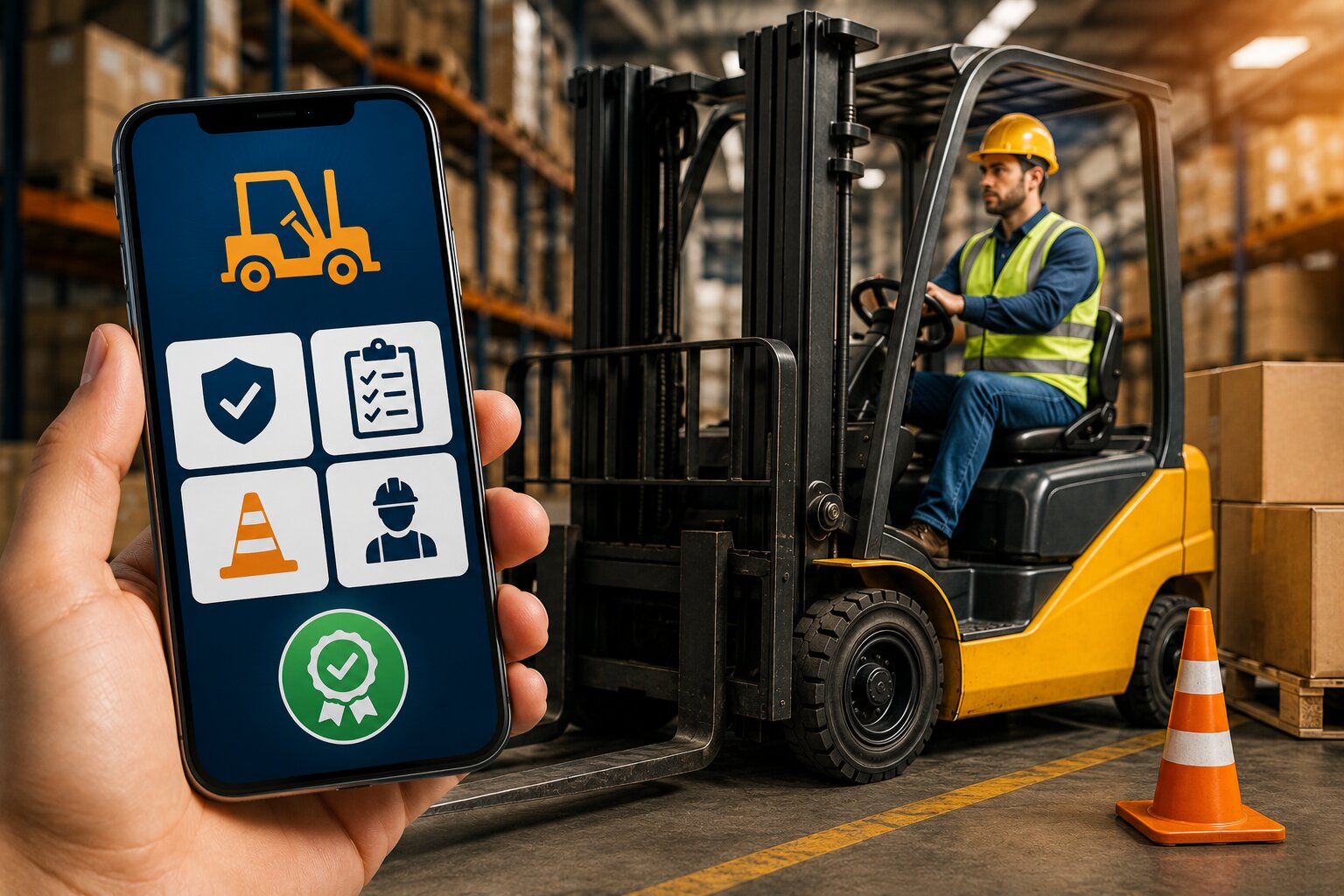
Forklift operators are among the most sought-after workers in the logistics industry right now.
Distribution centers, warehouses, and construction crews all need certified operators, and many of those employers will fast-track a hire who already shows up with documented training.
In most parts of the country, the pay is well above minimum wage, and a certified applicant is far easier to put to work than someone who still needs to be trained from scratch.
Start your training today
Free, flexible, practical, and you finish with a real certificate.
The old obstacle was always cost and logistics. Traditional forklift training meant booking a spot at a training center, clearing a full day off your schedule, and paying a couple hundred dollars for the privilege.
For workers juggling multiple jobs, a long commute, or a thin budget, that barrier kept the credential permanently out of reach.
That barrier no longer has to stop you. Web-based programs and mobile apps now deliver OSHA’s required formal instruction component directly from your phone, whether you are on a lunch break, riding transit, or winding down after a shift.
This guide covers what OSHA actually mandates, the platforms you can use right now, where the digital certificate fits in the overall process, and how to complete the loop with your employer so the credential actually holds up.


Why forklift certification is one of the smartest moves you can make
This credential is not just a regulatory formality.
It is one of the quickest ways to become a stronger candidate in warehousing and logistics, two sectors that keep expanding as e-commerce routes more goods through more fulfillment centers every year.
Certified operators can pursue roles that unqualified candidates cannot, and many job postings list certification as a hard requirement right in the listing.
There is also a business case for employers, and understanding it helps you see why the credential carries so much weight.
Running a forklift without proper training puts a company at risk of OSHA penalties and significant liability if an accident occurs on the floor.
When you walk in already trained, you eliminate a cost and a legal exposure for the company, and that immediately separates your application from the stack.
For you personally, the credential follows you from job to job and stays valid for three years, meaning the hours you put in now pay dividends across multiple positions.
The demand is real, not hype. Warehousing and logistics have added hundreds of thousands of positions over the past few years, and forklift operator appears repeatedly on lists of hard-to-fill roles.
Certified operators routinely earn more than general entry-level warehouse staff, and overtime is plentiful during peak shipping periods when facilities are stretched thin.
Few credentials you can earn in a single afternoon deliver this kind of return for someone trying to break into industrial work.
OSHA’s forklift certification requirements explained
In the United States, forklift operator training falls under OSHA 29 CFR 1910.178(l).
The core rule is simple: no one should operate a powered industrial truck on the job unless they have been properly certified first.
- Formal instruction through lectures, written material, or a digital course. This is the part an app or website can fully cover.
- Hands on practical training on real equipment.
- A performance evaluation by a qualified person who watches you operate.
Online platforms can only handle the first component, and that is precisely what every app and website in this guide does.
The remaining two components must be completed on actual machinery, at your actual workplace, with a qualified person reviewing your performance directly.
That division is the single most critical thing to understand before you start an online course.
Certification is also not a one-time event. Recertification is required every three years, and immediately if you transition to a different forklift type, are involved in an incident, or are flagged for unsafe behavior on the floor.
No federal government forklift license exists in the United States.
Instead, the employer holds the responsibility for certifying you using all three components above, and they maintain that record on file.
Keeping that certification current is a legal obligation for both the operator and the employer, not a suggestion.
How a forklift certification app actually works
A forklift certification app takes care of the knowledge and theory side of OSHA’s three-part requirement.
After creating an account, you move through a series of modules built from short video lessons, written content, and end-of-section quizzes while the app records your progress automatically.
Because the platform saves your place as you go, you can exit in the middle of any module and resume exactly where you left off whenever your schedule allows.
The average learner completes the full course in two to four hours of total study time, broken up however it fits, whether that is one long session or a handful of short ones spread across a few days.
After passing the final assessment, the platform generates a digital certificate of completion confirming you finished the formal instruction component of the requirement.
You can typically download or forward that certificate right away, so you can show up to your next shift the following morning with documented proof already in hand.
What you will learn inside a forklift training course
A thorough forklift training course covers every knowledge area OSHA expects an operator to understand before touching the controls. Expect modules on:
- Pre-shift inspections and how to document defects correctly
- Forklift classifications and the distinct handling characteristics of each type
- Emergency procedures and incident reporting requirements
- Load management, weight capacity, and the stability triangle
- Pedestrian safety and navigating shared floor traffic
- Safe maneuvering, covering speed, turning radius, and sightlines
Completing the theory before your hands-on evaluation gives you a real advantage.
You will arrive at the practical session more confident, and you will already recognize the terminology your evaluator uses when offering corrections in real time.
Forklift classes and which one you need
OSHA divides powered industrial trucks into seven distinct classes, and your certification applies only to the specific type you train on.
That is exactly why a new evaluation is required whenever you switch to a different machine class.
The types you are most likely to encounter in practice are:
- Class I: electric motor rider trucks, widely used in warehouses and cold-storage environments where exhaust fumes are not acceptable.
- Class IV and V: internal combustion cushion and pneumatic tire trucks, the classic sit-down forklifts you see on loading docks and outdoor yards.
- Class II: electric narrow-aisle equipment like reach trucks and order pickers, engineered for dense racking systems.
- Class VII: rough-terrain forklifts built for construction sites, lumber yards, and uneven ground.
Mastering all seven classes is not the goal.
Focus your initial certification on the equipment your current or target employer actually operates, and branch out into other classes as your career develops.
Knowing which class you need upfront also helps you select a training course that matches the real machine waiting for you on the floor.
From sign-up to certificate: the full process
The digital certification process follows a consistent pattern across nearly every platform, so understanding the flow once lets you get started on any of them right away:
- Create an account. Choose one of the platforms listed below and register with an email address. Free options let you begin immediately with no payment required.
- Complete the modules. Watch each lesson and answer the short quiz at the end of each section. You can pause and return at any time.
- Pass the final assessment. Most platforms require a score of roughly 80 percent, and retakes are usually available if you fall short the first time.
- Download your certificate. The platform delivers your proof of formal instruction, ready to save to your phone or forward by email.
- Arrange the hands-on evaluation. Bring the certificate to your employer and schedule the practical training and evaluation on real equipment, the step that completes your full certification.
Top platforms for online forklift certification training
Every option below is legitimate, and we have been straightforward about which parts are free and which carry a cost. None of them can certify you by themselves, because each one covers only the formal instruction component of the requirement.
What they accomplish is getting the knowledge work done quickly and at minimal expense.
| Platform | Cost | Format | Best for |
|---|---|---|---|
| Alison | Free | Web course | Getting a free certificate from a well-known platform |
| SkillCat | ~$10/mo | App + 3D sims | The most app like experience with practice |
| WorkHub | Free | Web course (EN/ES) | Employers training a whole team |
| OSHAcademy | Free to study | Web course | Sticking closest to the OSHA standard |
| ForkliftCertification.us | Free study | Practice exams | Drilling test questions before the exam |
| ForkliftPro | Paid app | Inspection tool | Staying compliant after you are certified |
Alison: free course with certificate of completion
Alison is one of the world’s largest free learning platforms, and their Forklift Operator Training course ranks among the most accessible options available today.
The curriculum covers forklift fundamentals, pre-shift inspections, load handling techniques, and the basics of OSHA compliance.
The course itself is completely free. You work through video lessons and module quizzes at whatever pace suits you, and Alison delivers a digital certificate the moment you finish.
If you want a physical copy sent to you by mail, that option exists for a small additional fee.
Alison also hosts free welding fundamentals and workplace safety courses, so you can build out a credentials portfolio from a single account.
SkillCat: affordable app with interactive 3D simulations
SkillCat is the most app-native option on this list.
Available on both Google Play and the App Store, it delivers OSHA forklift training through mobile-optimized modules and layers in interactive 3D simulations, so you can practice operating and inspecting a lift truck on screen before stepping near a real one.
The platform runs on a subscription of around ten dollars per month, which also opens access to hundreds of hours of additional trade training including HVAC and EPA prep.
It carries a cost, but for anyone who wants the most hands-on digital experience and values simulation practice, it is one of the least expensive routes to a formal instruction certificate.
WorkHub: free safety training designed for employer teams
WorkHub provides free online safety training, and their Lift Trucks and Forklifts course is one of the more polished choices for employers who need to get several operators through the theory quickly without hiring an outside instructor.
The portal is ad-supported and free, available in both English and Spanish, covering truck controls, load stability, operating procedures, and pedestrian safety in shared spaces.
WorkHub automatically logs each worker’s progress, so OSHA recordkeeping becomes straightforward when an inspector visits.
If your company already uses WorkHub for fall protection or confined space training, adding forklift certification is effortless since all completions live in one place under one login.
OSHAcademy: free study aligned tightly to OSHA standards
OSHAcademy offers a dedicated forklift operator course (course 620) that you can access and study at no cost.
A fee only applies if you want the official documentation and certificate upon completion, keeping the educational content itself freely available to anyone.
It is a reliable, no-frills option when you want content that stays faithful to the OSHA framework without any sales pressure attached.
ForkliftCertification.us: free study guides and practice exams
The Forklift Certification Institute maintains a free learning center organized into clear sections: introduction, the basics, OSHA training guidelines, forklift operations, safety, and a summary review.
Each section reads as a focused, digestible study guide rather than a dense textbook chapter.
The free tier provides flashcards, study guides, a 10-question practice quiz, and a 20-question practice exam, all OSHA-aligned and built to familiarize you with the style of questions you will encounter on the real assessment.
Practice exams can be retaken as often as needed, with an 80 percent passing threshold.
A separate paid tier adds an official exam and formal certificate for situations where your employer specifically requires documented third-party certification.
ForkliftPro: the compliance tool for operators already certified
ForkliftPro serves a different purpose entirely. It is not a training course. It is a compliance utility for operators who are already certified and need to stay that way.
Available on Google Play, the app is built around forklift inspection and maintenance documentation.
You conduct pre-shift checks using customizable inspection checklists, photograph any defect you find, and export PDF reports your employer stores for compliance records.
For fleet managers it replaces the paper inspection sheets most warehouses still depend on, and it earns its cost back the first time OSHA requests documentation and you can produce the complete file in under a minute.
With several solid options available, the best pick depends on your specific situation.
If your priority is no cost and a recognizable name, Alison or OSHAcademy are the natural starting points.
If your employer runs safety training through WorkHub already, use that platform so your completion record shows up in the same system they monitor.
If you learn better by practicing and can handle a modest monthly subscription, SkillCat’s 3D simulations offer the most interactive preparation available.
And if your main goal is preparing for the exam with practice questions, the free test bank at ForkliftCertification.us is the obvious choice.
Any of these platforms satisfies the formal instruction requirement, so you cannot make a wrong choice among them.
Can an app replace hands-on forklift training?
No, and this is the detail that trips most people up.
A forklift certification app covers the formal instruction component of OSHA’s three-part requirement.
It does not cover the remaining two.
Hands-on practical training and a live performance evaluation must still happen in person, with a qualified evaluator present.
In practice that means your employer, a direct supervisor, or a designated on-site trainer watching you operate real equipment under the conditions of your actual work environment.
OSHA specifically requires the evaluation to reflect the real conditions you will face on that job.
The digital certificate alone does not clear you to operate. The app is step one. The hands on evaluation with your employer is what actually closes the certification. Any site promising a complete, ready to work certification with zero in person steps is stretching the truth.
What the app provides is a documented record showing you completed the full theory curriculum, and that is genuinely valuable.
It positions you as an easy hire and allows you to handle all the studying on your own timetable.
Just go in with clear expectations: it is the first step of three, not the entire process.
Do employers and states recognize an online certificate?
This question concerns most people before they invest any time, and the answer becomes reassuring once you understand how the system is actually structured.
There is no state-issued forklift license to be recognized in the first place.
Certification is entirely employer-based throughout the United States, so what any employer is really looking for is evidence that you completed credible formal instruction, combined with their own hands-on floor evaluation.
A digital certificate from a recognized training platform is broadly accepted as proof of that formal instruction.
What employers will not accept is a digital certificate standing in for the practical evaluation, because OSHA holds them accountable for verifying you can operate their equipment safely.
The honest way to frame any online certificate is this: it gets you the majority of the way there and makes you an attractive hire, while your employer finishes the process with a short evaluation on the floor.
If a job posting specifically requests documented third-party certification, choose one of the paid programs above that issues a formal exam-based certificate.
Warning signs to avoid in online certification providers
Because forklift certification is a high-volume search topic, the space attracts a few providers operating in bad faith.
A few warning signs tell you to move on immediately.
Walk away from any site that claims to issue a fully valid, legally complete certification with no in-person component, because that is simply not how OSHA works.
Be skeptical of apps with generic branding and no traceable company behind them, particularly those demanding payment before you can see any course content.
And disregard anything advertising a forklift license, since that document does not exist anywhere in the United States government system.
Every legitimate platform listed here is transparent about covering formal instruction only, and that straightforwardness is the clearest signal you are dealing with a credible provider.
Why mobile-based training beats the classroom for cost and speed
For companies certifying multiple operators per year, shifting to mobile training is essentially a math exercise, and the numbers favor the digital approach.
Running a classroom session requires pulling workers off the production floor for half a day, aligning everyone’s availability, and often contracting an outside instructor to come on site.
A certification app lets each employee handle the theory on their own time, without disrupting shipping schedules or line output.
The per-employee cost difference is also substantial.
Free platforms exist, and paid options typically run between 20 and 60 dollars per user, versus several hundred dollars per person for conventional in-person instruction.
Record management becomes simpler as well. Rather than searching through filing cabinets for paper certificates, employers can retrieve individual completion records in a few clicks, which matters considerably when OSHA arrives without notice for an audit.
Skills to add once you have your forklift certification
Once you hold a forklift certificate, you have already started building a profile that warehouse and construction employers take seriously.
The workers who advance the quickest are typically the ones who keep layering in related credentials.
Welding certification is one of the most logical follow-up steps.
Many of the same facilities that depend on forklift operators also have ongoing demand for welders handling maintenance, repair, and fabrication work that keeps those operations running year-round.
You can get started on welding fundamentals through a free course on Alison, then progress to full welding certification through an accredited program.
A commercial driver’s license (CDL) is another strong option.
If you are already at ease around heavy equipment, a CDL expands your eligibility into trucking, delivery, and logistics positions that generally pay better than warehouse floor work.
Forklift certification is a strong foundation, and each additional credential makes you more valuable and harder to replace at any employer.
Frequently asked questions
Is forklift certification actually free?
The formal instruction portion can be entirely free on platforms like Alison, WorkHub, and OSHAcademy. What is never truly free is the complete certification, since OSHA also requires a hands-on evaluation conducted by your employer. So you can finish all the theory at no cost and complete the final step on the job.
How much time does it take to get certified?
Most learners finish the theory portion in two to four hours, which can be split across multiple short sessions. The hands-on evaluation with your employer typically takes less than an hour once it is scheduled.
Do I need access to a forklift to start the online course?
Not for the online portion, which is purely knowledge-based. You will need access to actual equipment for the practical training and evaluation, and that almost always takes place at your workplace on the machines you will be operating.
How often is recertification required?
Every three years under OSHA, and earlier if you change forklift types, are involved in an incident, or are observed operating in an unsafe manner.
Is the certificate valid in every state?
Yes. Forklift certification in the United States follows the federal OSHA standard and depends on employer evaluation rather than a state license, so a legitimate certificate is valid anywhere in the country.
Can I finish the entire certification on my phone?
You can complete all of the formal instruction on your phone, and that accounts for most of the total work. The final hands-on evaluation still has to occur in person on a real machine at your workplace.
What are the consequences of operating a forklift without certification?
Operating without certification violates OSHA, and the penalties land most heavily on the employer, who can face fines running into thousands of dollars per violation. You can also be removed from the equipment on the spot during an inspection. That is precisely why employers prefer candidates who already arrive with documented training.
Where do I look for forklift jobs after getting certified?
Distribution centers, warehouses, manufacturing plants, construction sites, and retail backrooms all hire certified operators regularly. General job boards work well, but staffing agencies that focus on industrial and warehouse placements tend to connect certified operators with employers the fastest, sometimes within a matter of days.
Take your first step this week
Getting forklift certified no longer requires clearing your schedule for a full day at a training facility.
Choose one of the platforms above, knock out the theory portion this week on your own time, and then coordinate with your employer to schedule the hands-on evaluation.
The path is straightforward: study on your phone, pass the assessment, then demonstrate on the floor that you can operate the equipment safely.
That is the full sequence from interested to certified, and for many people it takes less than a week to complete.